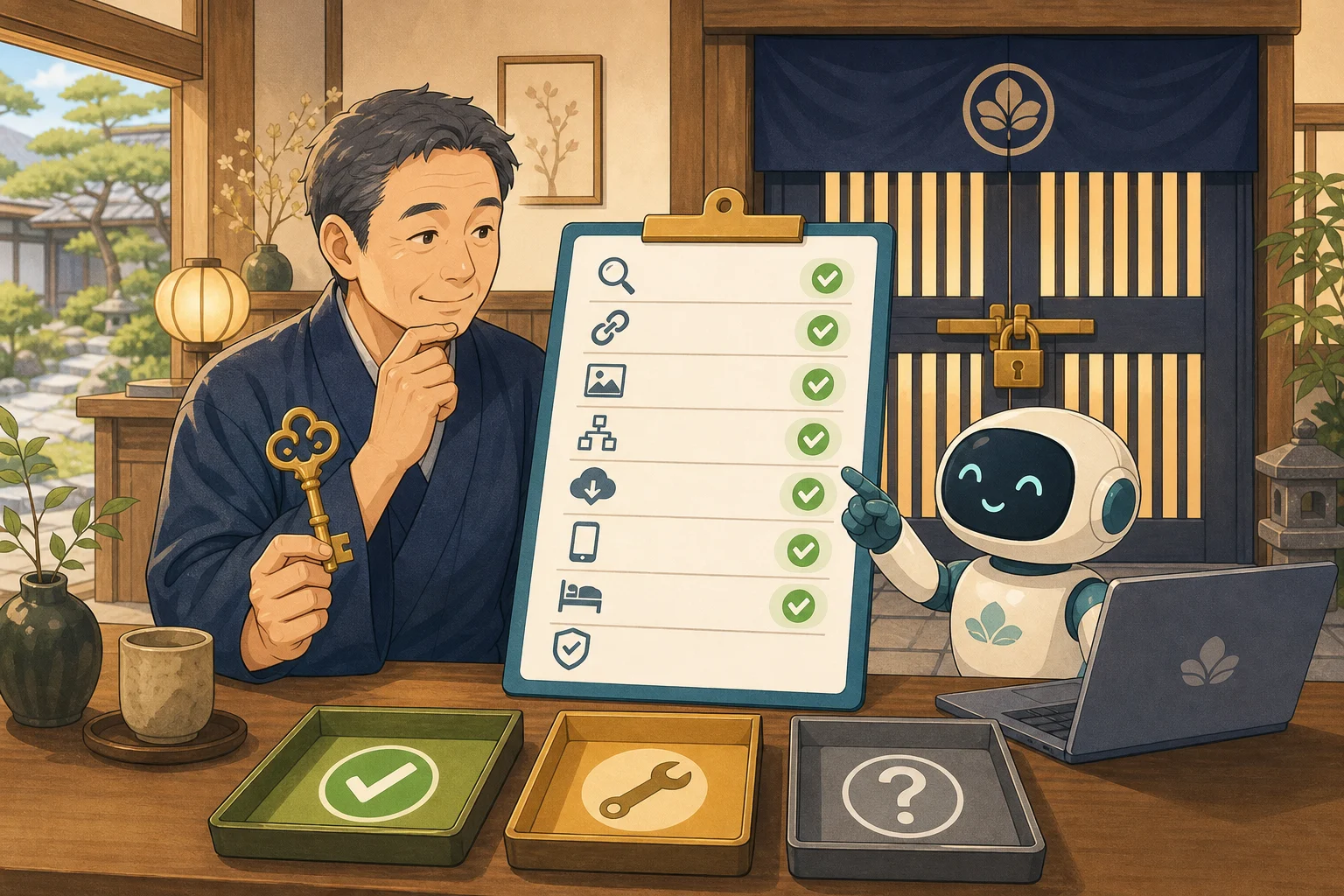
Even if the article manuscript is completed, there is no need to publish it immediately. Are the inn name, rates, business days, reservation conditions, and resident cat information correct? Do you have the right to post the image? Have unrelated articles or settings changed? Confirm before hitting the publish button.
The AI automatically checks a number of items, but the host makes the final decision as to whether it can be published. In this article, we will explain how to divide the pre-publication confirmation results into three categories: Can be published, Requires correction, and Judgment pending.
- Difference from post-publishing confirmation
- Narrow down to one publication target first
- Things to prepare before publishing
- There are three judgments: “Publishable, Revision required, Judgment pending”
- 1.Check your purpose and audience
- 2.Check the facts and official information of the accommodation
- 3.Look for unconfirmed information and assertions
- 4.Separating actual experience from research articles
- 5.Check image rights and description
- 6.Check links and reader return directions
- 7.Check WordPress post attributes
- 8.Check SEO and overlap
- 9.Check the impact on reservations/inquiries
- 10.Check the change range and differences
- 11.Check backup and stop conditions
- Pre-publication audit prompt passed to AI
- Host confirms AI audit results
- After modification, re-audit the whole thing, not just the changed part.
- Summary
- Reference materials
Difference from post-publishing confirmation
The purpose is different before and after publication.
| Time point | Main purpose | What to do in case of failure |
|---|---|---|
| Before publication | Prevent false information and unnecessary changes from being released | Withhold corrections or publication |
| After publishing | Check the actual URL, display, link, and reservation entrance | Check the impact and decide whether to modify or unpublish |
Before publishing, we will check the manuscript, changes, WordPress draft, and settings schedule. After publishing, check the pages that the general reader will see. By doing both, you can find problems that may be correct in the manuscript but cause problems in the actual display.
The steps after publishing are explained in HTTP/SEO/Smartphone display check.
Narrow down to one publication target first
Before the audit, pin down what will be published in one sentence.
Target: 1 article for hosts
slug:inn-owner-example
What to publish: Markdown manuscript, specified eye catch, internal link from hub
What will not be published: Other articles, themes, plugins, server settings
If you ask them to “confirm everything and make it public” while the target is vague, the scope of audits and changes will expand. If there are multiple articles or setting changes, judge them one by one or clearly separate the work units.
Things to prepare before publishing
- Final candidate manuscript
- Images used and source/permission records
- Official information referenced and confirmation date
- List of internal links to add/change
- Poster, category, and tags set in WordPress
- title、slug、description
- Difference before and after change
- How to properly backup and restore
- URLs and items to check after publishing
Even if these are not complete, the AI will not fill it in with guesses and will leave it as “unconfirmed”.
There are three judgments: “Publishable, Revision required, Judgment pending”
Available for publication
The confirmation items have been met, and the remaining minor points do not affect the decision to publish. Please report what you have confirmed and the evidence.
Needs correction
This is when you know what to fix and the correct state, such as typos, broken links, missing descriptions, or missing internal links. Audit again after fixing.
Judgment pending
AI alone cannot determine right or wrong in terms of fees, business conditions, image permission, current cat information, impact on reservations and payments, etc. We will not publish the information until we confirm with the person in charge or official materials.
“Cannot confirm, but probably correct” is not included in the publishable category.
1.Check your purpose and audience
- Whose questions does this article answer?
- What do you want them to do after reading?
- Are you repeating the same conclusions as existing articles?
- Does the title and body match?
- Can you understand the target audience and conclusion at the beginning?
We do not add words that are not answered in the main text to the title just to include search terms. Match the title, description, and body promise.
2.Check the facts and official information of the accommodation
Please check the following items on the accommodation website.
- Facility name, location, phone number, official URL
- guest room, capacity, facilities, meals
- Check-in/Check-out
- Business days, closed days, seasonal operations
- Rates, taxes, fees, payment terms
- Cancellations, changes, no-shows
- Parking, transportation, public transportation
- A place where resident cats can stay, rest, and interact with each other
Rates and service specifications will leave the confirmation date and official confirmation address. The method for checking the evidence shown by AI is explained in Primary information confirmation technique.
3.Look for unconfirmed information and assertions
AI connects sentences naturally, so it may even supplement content that is not in the materials. Find the following expression:
- Always, always, all rooms, free, cheapest, complete
- Popular, reputation, safe, recommended
- Cats will definitely come and you can always interact with them.
- Pick-up and drop-off available, child-friendly, allergy-friendly
- Automatic linkage, immediate reflection, refund possible
This does not mean that all of these are wrong. Check if there are grounds, targets, and exceptions. If you cannot confirm, either limit the wording or return to checking with the accommodation.
4.Separating actual experience from research articles
In articles where I did not actually stay there, I do not write about experiences such as “I had a good time,” “I had fun,” or “A cat came to my room.”
- Facts from overnight stay coverage
- Information provided by the inn
- Information confirmed on the official website
- Investigation candidates obtained from third party information
- unconfirmed matters
These are expressed separately. If the article is from before the on-site interview, clearly indicate that it is a research article and the date of confirmation.
5.Check image rights and description
- Did you take the photos yourself or did you get permission from the hotel to post them?
- If it is a free material, have you checked the commercial usage conditions?
- Did you record the distribution page, author, and date of acquisition?
- Did you write “Illustrative image” on images that are not actual inns or cats?
- Are you using the same free image in different articles?
- Are there any consent or privacy issues when people are included in the photo?
- Does the alt text explain the role of the image?
AI-generated images do not provide explanations like documentary photos taken of real inns or resident cats. Images from official websites and reservation sites will not be reproduced without permission.
6.Check links and reader return directions
- Is the official link the correct operator/domain?
- Does the internal link URL exist?
- Are you linking to old articles or the wrong domain?
- Can you follow new articles from hubs and categories?
- Can you return to the main article from the new article?
- Can you tell the destination just by link text?
- Don’t confuse the reservation button and the reference material link.
In addition to publishing articles, we will also provide an entrance and return route at the same time. Use categories and hubs instead of lining up all articles in headers.
7.Check WordPress post attributes
Apart from the main text, check the settings on the WordPress side.
| Item | Confirmation details |
|---|---|
| Posted by | Is this the correct poster as determined by the inn or site? |
| Status | Draft, private, or published |
| slug | Is there no duplication and can it be used in the future |
| Category | Is the parent/child classification correct? |
| Tags | Did you name the facility and its purpose according to the rules |
| Eye catch | Are the images, rights, and alternative text correct |
| description | Does it accurately summarize the text |
| Markdown | Is there a setting for the format used on the site |
When updating an existing article, make sure that you do not accidentally replace all the current categories and tags.
8.Check SEO and overlap
- Is the title unique and represents the content of the text?
- Is the description a copy of another article?
- Is there one H1 and the heading order is natural?
- Is there already an article with the same search intent?
- Are the plans for canonical and robots correct?
- Is it a public article to be posted on the site map?
- Are you confusing the update date and confirmation date?
SEO verification is not a matter of counting the number of keywords. Be sure to fully answer readers’ questions, avoid duplicate articles, and help search engines understand the role of your page.
9.Check the impact on reservations/inquiries
Even if the article is published, changing the menu or common parts may affect the reservation flow.
- Have you changed the URL of the reservation button?
- Are the phone number, business hours, and contact information correct?
- Are you sending test messages that include personal information to the reservation form?
- Do you unintentionally send information to an external reservation screen?
- Are the rates and cancellation conditions consistent with the reservation screen?
- Are basic authentication and security settings changed at the same time?
Pre-publication audits do not perform genuine reservations, inquiries, phone calls, payments, or refunds. Use fictitious test data and dedicated environments if necessary.
10.Check the change range and differences
Let the AI compare the requested changes with the actual differences.
- Only files and posts that were planned?
- Are unrelated sentences or designs changed?
- Is there any information that has been deleted?
- Are new external scripts or communication destinations increasing?
- Does the manuscript contain confidential information or internal environment?
- Are there any omissions in correcting old expressions?
If the difference is larger than expected, we will hold off on publishing until we understand the reason.
11.Check backup and stop conditions
Before publishing, check whether the backup was successful, not whether the backup command was executed.
- Is the exit status successful?
- Checksums match?
- Are the necessary files and databases included?
- Do you know the restoration procedure and the person in charge?
- Is there a risk of losing reservations/inquiries after backup?
Also determine in advance the conditions for continuing backup if it fails. We do not treat changes that can be made private, such as a new article, and changes that pose a high recovery risk, such as data deletion, migration, restore, or update.
Pre-publication audit prompt passed to AI
Please audit this change before it goes live.

Purpose: [Publishing articles/updating existing pages, etc.]
Target: [Manuscripts, submissions, images, internal links]
What can be changed: [Candidates for approval]
Not applicable: Other articles, themes, plugins, servers, reservation/customer/payment data

Please check the following:
1. Matching audience, purpose, title, and text
2. Inn name, rates, business hours, reservation conditions, basis and confirmation date of resident cat information
3. Unconfirmed information, excessive assertions, and fictional experiences
4. Image rights, sources, Illustrative image notation, alternative text
5. External links, internal links, entry and return routes from the hub
6. Poster, slug, category, tag, eye catch, description
7. SEO, duplicate articles, canonical, robots
8. Impact on reservations, inquiries, calls, and maps
9. Unplanned differences, confidential information, and internal environment contamination
10. Normal completion of backup, consistency, and termination conditions

Please mark each item as "confirmed/requires correction/decision pending" and provide evidence.
Please report any serious issues first, and indicate the overall publication decision as either "Publishable/Requires correction/Decision pending."
This time it's just an audit. Please do not modify or publish files, WordPress, production sites, or external services.
Host confirms AI audit results
Even if the AI determines that it can be published, the host itself will confirm the next step.
- Matches the current information of the inn
- Photos and text that are acceptable for publication
- No misunderstandings regarding rates, reservation conditions, and cancellation conditions
- This is an expression that respects the resident cat’s will and physical condition.
- There are no problems with the publication range and time.
- Understand unconfirmed items
On-site circumstances that cannot be confirmed by AI will be determined by humans.
After modification, re-audit the whole thing, not just the changed part.
A single modification can change the consistency of headings, links, descriptions, and internal link destinations. After fixing the “Requires correction”, check not only the differences but also the entire publication target again.
If you ultimately approve, please specify the target.
I have reviewed the audit results and revised version.
Only [post name, slug, image, internal link] will be approved for publication.
Please do not change anything that is not applicable.
After publishing, please check the HTTP response, PC/smartphone display, text, images, links, and reservation entrance, and report unconfirmed items and failures without treating them as completed.
Please see How to separate “investigate” and “change” for how to divide the process from investigation to publication into stages.
Summary
Pre-release audits are not just about looking for typos. In fact, it’s a process of checking image rights, links, post attributes, SEO, reservation paths, change differences, backups, and finding the reason why it can’t be published before it goes out.
AI will be used to assist in checking all items, and the final decision on whether or not to publish will be made by the host, who knows the site and rights. After publishing, please check the actual URL and display separately.
Reference materials
- Google Search Central: Useful, reliable, user-first content
- Google Search Central: Search result snippet and description
- OpenAI official: Agent approvals & security
- Anthropic official: Claude Code Security
Note: Specifications of AI, WordPress, and search services may change. When using the site, please also check official materials and site-specific operating rules.