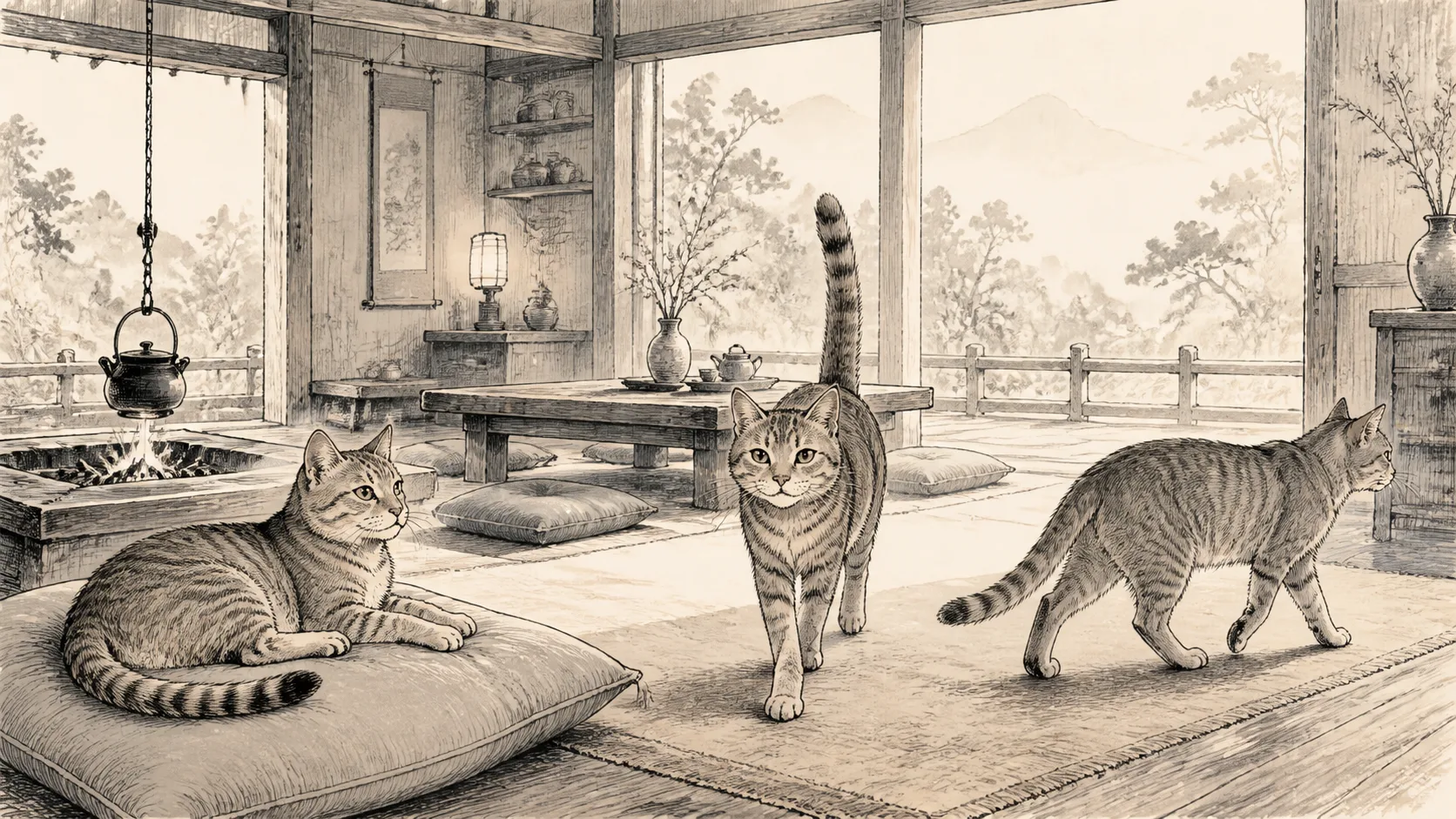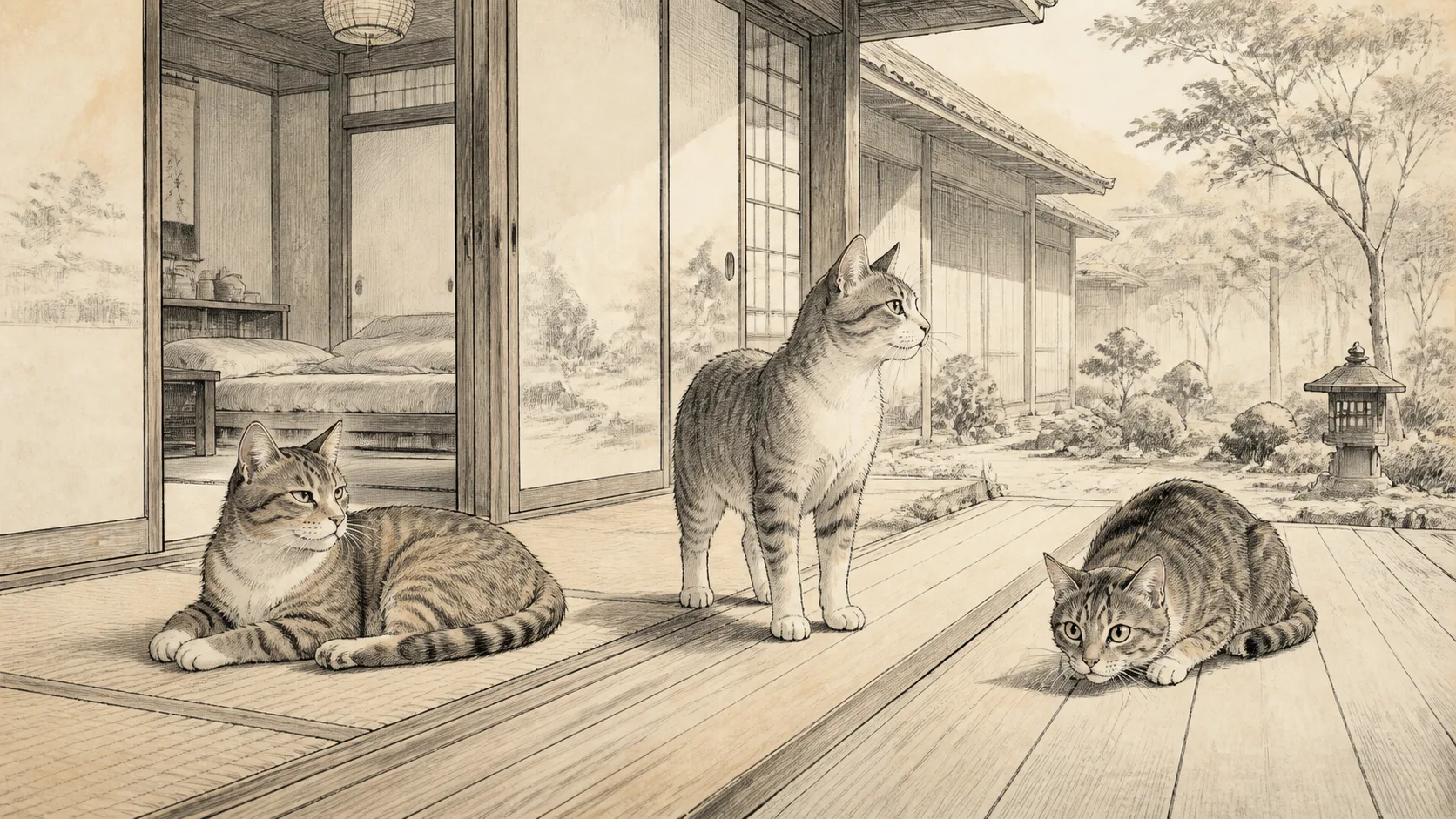
A cat’s ears, eyes, and posture can give you clues about how it feels. However, you cannot decide on your own that a cat is in a bad mood merely because its ears are turned to the side, or afraid merely because its pupils are large.
The ears move to search for sounds, and the pupils change depending on the brightness. At Nekoyado, we look at the animal’s whole body, surrounding area, and any changes from the previous time, and carefully decide whether to continue contact.
- Observation order
- Don’t rush into contact even with forward-facing ears
- Ears move to the side or back
- Pupil size also changes depending on brightness
- look away, turn away
- Body stiffens low
- Check the posture of lying down for tension as well.
- Also look at the whiskers and mouth as an auxiliary view.
- Changes during touching
- Guests don’t have to decide
- Summary
- Reference materials
Observation order
Before approaching the detailed expressions, look at them from a distance in the following order.
- What does the cat do?
- Is the cat’s body relaxed or stiff?
- Is the cat approaching people or moving away from them?
- What are the cat’s ears and eyes directed toward?
- Are there any changes in the tail and whiskers?
- Are there sounds, people, or other cats around?
By first looking at the movement and the whole body, it becomes difficult to attach too much meaning to one part.
Don’t rush into contact even with forward-facing ears
If the cat’s ears naturally point forward, its body is flexible, and it approaches people on its own, it may be calm and checking its surroundings. However, the forward-facing ear may simply focus on sounds or objects.
Stay out of the path of a cat whose attention is focused on food, toys, birds, etc., and wait to see if the cat starts making contact with you.
Ears move to the side or back
When ears momentarily turn to the side, the cat may have just heard a sound behind it. If both ears flatten back, the body becomes low and stiff, the cat stares at the hands, and it tries to pull away, stop contact.
Rather than “keep stroking until the ear is back”, use small changes as a signal to pause.
Pupil size also changes depending on brightness
In the dark inside the inn, even a calm cat’s pupils will enlarge. It also changes in situations of high arousal, such as playing or exploring.Commentary on cat emotional evaluation states that although large pupils indicate the level of arousal, they cannot independently determine whether the emotion is positive or negative.
Don’t just judge by the eyes; look at the height of the body, ears, tail, breathing, and direction of movement.
look away, turn away
If the cat averts its eyes or turns its face away, wait without increasing contact. There are multiple possibilities, including drowsiness, checking the surroundings, and wanting to keep a distance.
Do not make sounds or support the cat’s chin with your hand to turn its face back toward you. Do not direct the cat’s gaze for photographs without the inn’s permission.
Body stiffens low
A cat holding its body low to the floor, with tense muscles and paws ready to move, can be associated with anxiety and readiness to escape. Don’t interpret the fact that it’s not running away as “it’s okay to touch the cat.”
The person backs up to clear the cat’s hiding place and passage. Do not reach out to the frozen cat or try to pick it up and carry it to safety, and notify staff if necessary.
Check the posture of lying down for tension as well.
Even if the cat lies down with its stomach showing, its body may be stiff, its front paws may be in the position to your hand, or its eyes and ears may be following you. It is dangerous to make judgments based solely on photos that imitate the form of relaxation.
Without touching the belly, look at the tension in the face, back, and legs. Make sure the cat has space to leave without having to change its posture first.
Also look at the whiskers and mouth as an auxiliary view.
There is a difference between a state in which the whiskers naturally spread to the side and the facial muscles are soft, and a state in which the whiskers point strongly forward, follow the face, and the mouth is tense. However, it may be difficult to see depending on the hair color, facial features, and angle.
Don’t get close to the face when you can’t tell, and prioritize posture and movement.
Changes during touching
Even if the cat is calm before contact starts, its state can change during contact.
- Ears turn towards hands
- The cat opens its eyes wide and looks at the hand
- The cat suddenly turns its head
- Body becomes stiff
- Skin and tail move
- The cat moves its paws and tries to leave
If even one change occurs, stop touching the cat. If the cat doesn’t ask for contact again, it’s over.
Guests don’t have to decide
Even experts evaluate cat signs, including context. Guests do not need to guess the emotion name. It is sufficient to decide, “I don’t know, so I won’t touch it,” or “I’ve noticed a change, so I’ll stop.”
If you notice any unusual behavior or concerns about the cat’s health, don’t touch the cat yourself and report it to the hotel staff who know the cat.
Summary
Ears, eyes, and posture are not seen as individual shapes, but as combinations and changes. First check what the cat was doing, whether it is approaching or moving away from people, and what is around it, and if in doubt, stop contact. This view reduces misreading of the sign.
Also see A cat’s feelings based on tail movements and How to tell when it’s okay to touch them.
Reference materials
- Recognising and assessing feline emotions
- Development of an ethogram for identifying feline emotions
- 2021 AAHA/AAFP Feline Life Stage Guidelines
Note: This article is not intended to diagnose a cat’s emotions, pain, or illness. Please prioritize the rules of the accommodation and the judgment of the staff.