When you look into making accommodation reservations online, you’ll come across the terms “reservation engine,” “site controller,” and “PMS.”The names and scope of functions vary depending on the service, and a single product may have multiple roles, so you cannot choose one based on the name alone.
To summarize first, the main roles are:
- Reservation engine: accept reservations on the official website of the inn, etc.
- Site controller: Synchronize inventory, prices, and reservation information for multiple sales destinations
- PMS: Manage room allocation after reservation, check-in, cleaning, accounting, customer information, etc.
This article assumes a small guest house, inn, or pension, and explains how to determine the necessary system based on the current reservation route and daily operations.
- First, consider the reservation process in one piece.
- Reservation engine: Entrance for receiving reservations on the official website
- Site controller: Connect multiple sales destinations
- PMS: Manage accommodation operations after reservation
- Compare the three differences
- Deciding “which is the original”
- How to choose a small accommodation
- Ask the service provider before comparing
- The demo recreates a real day
- Common selection mistakes
- Pre-implementation checklist
- Prompt for AI to help with comparison
- Summary
- Reference materials
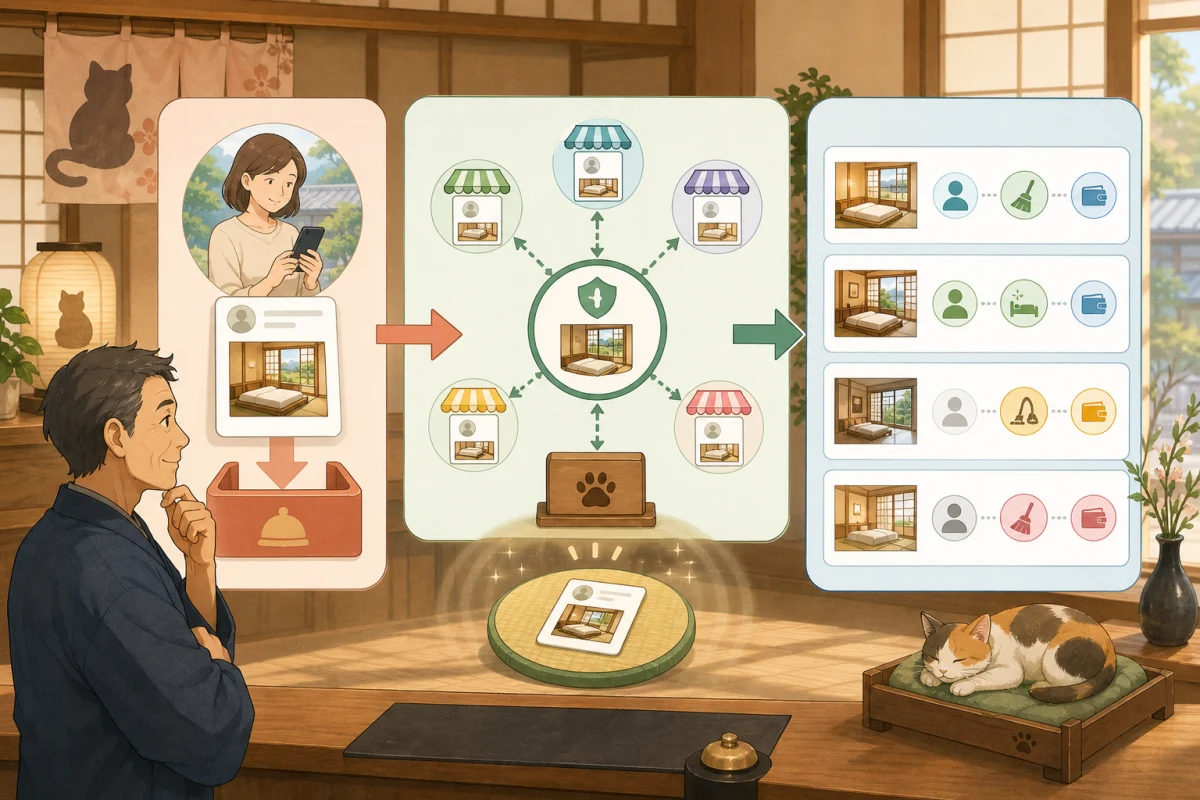
First, consider the reservation process in one piece.
Traveler
├── Official inn website ── Reservation engine ─┐
├── OTA A ────────────────────────────────────┤
├── OTA B ────────────────────────────────────┼─ Channel manager ─ PMS
└── Phone / email ────────────────────────────┘                     │
                                                                    ├─ Room allocation
                                                                    ├─ Check-in
                                                                    ├─ Cleaning / meal instructions
                                                                    └─ Accounting / customer management
This is a general diagram to understand the role. In reality, there are products that combine a reservation engine and site controller, integrated models that include PMS, and operations that allow telephone reservations to be entered directly into PMS.
This does not mean that you must contract for three types of products separately.
Reservation engine: Entrance for receiving reservations on the official website
Reservation engines are also called in-house reservation systems, web reservation systems, booking engines, etc. The official website of the inn has a “Search for vacancies” and “Make a reservation” buttons, where travelers can apply by selecting the date, number of people, room, and plan.
Examples of key features include:
- Search for vacancies by date and number of people
- Display of guest rooms, accommodation plans, and prices
- Enter reservation information
- Reservation reception and confirmation email
- Cancellation reception
- Coupons and member rates
- Online payment
- Multilingual display
- Display reservation terms and cancellation conditions
Differences from the reservation form
You can send your desired dates of stay using the regular inquiry form, but this does not necessarily guarantee availability. If the reservation is not finalized until the inn replies, the operation is similar to accepting reservation requests.
Reservation engines are generally configured to allow you to view inventory and prices and confirm reservations on the spot. However, depending on the service and facility settings, “reservation requests” may also be made, so we will clarify when the reservation is established in the terms of service and confirmation email.
Accommodations where a reservation engine alone may be sufficient
- Few guest rooms
- Sales mainly on official website
- No OTA or only one
- The current ledger is sufficient for room allocation and cleaning management.
- People can check reservation information every day
However, make sure that the same person can quickly update inventory for phone and online reservations.
Site controller: Connect multiple sales destinations
OTA refers to online travel agencies and accommodation reservation sites. If you sell the same guest room on multiple OTAs and official websites, you will need to register inventory and prices with each and update them every time you make a reservation or cancel.
The site controller has the role of managing multiple sales destinations in a summary manner and coordinating inventory, prices, plans, reservation information, etc. It is sometimes called Channel Manager in English-speaking services.
Mechanism to reduce double reservations
If the remaining room is booked on OTA A, if the inventory on OTA B and the official website can be stopped immediately, the risk of selling the same room to two people can be reduced.
However, installing a site controller does not mean that double reservations will never occur.
- There is a time lag in collaboration
- Some plans or sales destinations are not supported.
- Forgot to enter phone reservation
- Wrong linking of room type
- Communication failure or maintenance may occur
- Inventory units are different between the OTA side and the facility side
At the time of implementation, check which sales destinations and what will be linked in real time. Merely indicating that “linkage is possible” does not necessarily mean that inventory, prices, reservations, cancellations, plans, and payment information all work in both directions.
Accommodations that tend to require a site controller
- Selling the same guest room on multiple OTAs
- I want to make the reservation stock on the official website the same as OTA.
- I want to reflect prices and sales suspensions on multiple sites at once
- Transcribing reservation notifications is becoming a burden.
- Inventory update delays and input errors are increasing.
PMS: Manage accommodation operations after reservation
PMS stands for Property Management System. The Japan Tourism Agency also describes it as a customer reservation management system, and it is the central system that supports accommodation reservations and inside the inn operations.
The scope of functionality varies greatly depending on the product and facility size, but examples include:
- Reservation ledger
- Guest room assignment
- Check-in/Check-out
- Guest information and customer history
- Cleaning status and guest room status
- Instructions for meals, allergies, transportation, etc.
- Sales, billing, deposits, receipts
- Occupancy rate and sales report
- Business related to guest list
- Cooperation with electronic locks, POS, payment, accounting, etc.
PMS is not a reservation site
Even if PMS has a reservation ledger, it does not necessarily mean that travelers can make reservations from the official website. You may need a separate integration to receive data from a booking engine or OTA.
On the other hand, if the reservation engine has simple customer management and check-in functions, a separate PMS may not be necessary for small facilities.
Accommodations that tend to require PMS
- As the number of guest rooms and staff increases, it is difficult to share using paper or spreadsheets.
- I want to link room allocation, meals, cleaning, and accounting after making a reservation.
- I want to consolidate phone, OTA, and in-house reservation information into one place.
- Confirm simultaneously with multiple staff and multiple facilities
- I want to use customer history, sales, and occupancy rates to improve operations.
Compare the three differences
| Perspective | Booking Engine | Site Controller | PMS |
|---|---|---|---|
| Main users | Travelers who make reservations and reservation staff | Sales and reservation staff | Front desk, cleaning, accounting, management, etc. |
| Main roles | Receive reservations on the official website | Synchronize inventory, prices, and reservations from multiple sales destinations | Manage accommodation operations after reservations |
| Main targets | Date, number of people, plan, reservation person input | OTA/official reservation inventory and sales information | Room allocation, guests, guest room status, accounting, etc. |
| Is it needed even with only one OTA? | Candidate if you receive reservations from your own company | May not be necessary if manual work is sufficient | Inside the inn Determine based on the complexity of the business |
| Countermeasures against double reservations | Can be managed within your own inventory | Mainly synchronization of multiple sales destinations | Summary of linked reservations and telephone reservations |
| Product form | Single or integrated type | Single or integrated type | Single or integrated type |
This table is for general roles. Even if “PMS” is written in the product name, it may include a site controller or a reservation engine. When comparing, check not the product classification, but the extent to which the necessary operations are included.
Deciding “which is the original”
When linking multiple systems, if it is unclear where to modify the same reservation or inventory, data will be inconsistent.
For example, decide on the following before implementation:
- Where do I create guest rooms and room types?
- Where should I enter the basic inventory?
- Which is the original source for prices and plans?
- Where should I register my phone reservation first?
- Where can I receive cancellations and how much will they be automatically reflected?
- Where to correct guest information
- Where can I check if my payment has been completed or not yet paid?
- What is correct if different numbers come out for each system?
Even if it is explained that “everything is connected”, it does not mean that the correction direction and reflection time will be the same. Confirm the coordination diagram and operational procedures with the service provider.
How to choose a small accommodation
Step 1: Write down the current reservation route
Using the past month or busy season as an example, write down the following numbers and tasks.
- Telephone reservation
- Email/Inquiry form
- Official website reservation
- Reservations by OTA
- Reservations from regular customers and travel agencies
- Same-day reservations and walk-ins
Each time a reservation, change, or cancellation is made, it also records who updates which ledger and how many times.
Step 2: Choose one task that you are having trouble with
Different purposes require different mechanisms.
| Main problems | Roles to consider first |
|---|---|
| I can only take phone calls and miss out on reservations outside business hours | Reservation engine |
| Inventory updates for each OTA is a burden, and I am worried about double reservations | Site controller |
| Room allocation, cleaning, and sharing of accounts after reservation is complicated | PMS |
| All three are disconnected and require frequent manual transcription | Combination or integrated type that can be linked |
Rather than “introducing a highly functional system,” make the purpose more specific, such as “eliminating one transcription that occurs every day.”
Stage 3: Configure from the bare minimum
There are few guest rooms, mainly official reservations.
A reservation engine and an operation that immediately reflects telephone reservations in inventory may be sufficient. Even if you install a highly functional PMS, it is not suitable if it only increases the input work.
Sold on multiple OTAs and official website
Site controller priority will be increased. Make sure all OTAs and booking engines in use are compatible and can correctly link room types and plans.
Share inside the inn tasks with multiple staff members
A candidate configuration is one that aggregates reservations from site controllers and reservation engines, centering on PMS.We also make sure that front desk, cleaning, and meal staff can each view only the information they need.
Solo or family business
Rather than the number of functions, we emphasize setting agency, telephone support, alternative operation in the event of a failure, and ease of understanding billing. Avoid situations where only one person can understand the settings.
Ask the service provider before comparing
Cooperation
- Can it be linked with the OTA, reservation engine, and PMS that you are currently using?
- Which of inventory, prices, reservations, changes, and cancellations will be linked?
- One way or two way?
- Normal reflection time and behavior during failure
- Can you handle room types, meal plans, consecutive nights, and child rates?
- Can I change the link destination later?
Reservation operation
- When the reservation is made
- Division of responsibility and contact point in case of overbooking
- How to register telephone reservations, closed days, exclusive-use stays, and rooms blocked from sale
- How to handle cancellation fees and refunds
- How reservation changes are communicated to each sales destination
Payment
- Can you handle both local and online payments?
- Payment agency and contract entity
- Payment fees, refund fees, deposit cycle
- Is it configured so that the card information is not retained by the inn?
- Claim procedure for cancellation/no-show
Reservation systems and payment systems have different roles. Even if the booking engine has a payment function, we will separately check the conditions for contracts, fees, deposits, refunds, and identity verification.
Data and permissions
- Where is guest information stored and who can view it?
- Can authority be divided by staff?
- Does the operation history remain?
- Is it possible to remove access for retired employees and production companies?
- Data retention period and deletion method
- Can reservation/customer/sales data be output at the end of the contract?
- Output format and availability of migration support
Obstacles and Support
- Can I make a reservation in case of a problem?
- How to notify that inventory synchronization has stopped
- How to contact us at night and on holidays
- How to check for duplicate or missing reservations after recovery
- Who will do the initial setup, data migration, and staff training?
- Is the manual understandable even for people who are new to IT?
The demo recreates a real day
In addition to viewing the list of features, use a fictitious reservation to:Information about actual guests will not be entered into the demo.
- Reserve a room from the official website
- Check whether the remaining rooms at other sales destinations have changed.
- Add phone reservation
- Change date, number of people, meals, and room
- Cancel one item
- Check the status of your refund or on-site payment
- Share room allocation and cleaning status
- Output reservation list and sales
- Change staff authority
- Ask for alternative procedures if communication is not possible
Try not only daily operations, but also exceptions for changes, cancellations, and failures to see the real burden.
Common selection mistakes
Select based only on monthly fee
Compare the total amount including initial cost, reservation fee, payment fee, addition of cooperation, support, data migration, and device cost. Even if it is cheap, if the transcription work remains, the cost of human time and mistakes will continue.
We think that the more functions there are, the safer it is.
If there are many unused functions, the number of initial settings, training, authority management, and failure points will also increase. Separate your current work from the work you will need a year from now.
See only the number of supported OTAs
It is important to be able to properly collaborate with the OTA that your inn actually uses, in terms of the plan and inventory you need.
Do not include telephone reservations in the operation diagram
Even if your online inventory is synchronized, it won’t prevent double bookings if no one enters a phone reservation. Includes patrons, groups, travel agencies, and private parties.
Do not check when the contract ends
Avoid problems such as not being able to provide customer/reservation data when switching, not being able to see past documents, or having the domain or payment contract in the name of the provider. Before signing a contract, confirm the assets that the inn will continue to manage and the cancellation procedures.
Pre-implementation checklist
- Write down the current reservation route and number of reservations
- Understood transcription work when making reservations, changes, and cancellations.
- I decided on one problem to solve first.
- Separated the necessary roles of booking engine, site controller, and PMS
- Decided which system will be the primary source for inventory, prices, and reservations.
- Confirmed cooperation items and direction with all sales partners
- Decided on how to register for phone reservations and private reservations
- I have confirmed the online payment contract, fees, and refund conditions.
- Confirmed staff privileges, operation history, and storage location of personal information.
- Provided contact information and alternative procedures such as paper and spreadsheets in case of failure.
- I tried reservations, changes, cancellations, and refunds in the demo.
- Confirmed data output and migration conditions upon cancellation
- Compare not only monthly costs but also total costs
Prompt for AI to help with comparison
Since service fees and partner locations change, we will record the official page and confirmation date of the quote. Management screen passwords and existing reservation information will not be passed to AI.
Please help me choose a reservation system for a small inn.

First, ask and sort out the following:
- Number of guest rooms and room types
- Number of reservations by phone, official website, and OTA in use
- Currently used reservation ledger, payment, and accounting system
- Trouble with reservations, changes, and cancellations
- Number of staff and required permissions
- Necessary multilingual, payment, cleaning, meal, and accounting functions
- A budget that includes not only the monthly amount but also initial costs and fees.

Then divide the required roles into
"Reservation Engine", "Channel Manager", "PMS", and "Payment".

Do not recommend the same product to every inn. Make a table of features verified
in official information, unconfirmed points, and questions to ask when requesting a quotation.
Please do not handle actual guest information, passwords, or card information.
Summary
The reservation engine is the gateway for accepting reservations on the official website, the site controller is the mechanism that synchronizes inventory, prices, and reservations from multiple sales destinations, and the PMS is the platform that manages room assignments, check-in, cleaning, accounting, etc. after reservations.
Functions may overlap depending on the product. Instead of thinking about buying all three separately, write down your current reservation route, transcription work, and inside the inn work, and choose the role you need based on the problem you want to solve first.
The success or failure of implementation depends not only on the number of functions, but also on the scope of cooperation, the original system, input of telephone reservations, alternative operation in the event of a failure, and whether data can be migrated at the end of the contract.
How to compare specific candidates under the same conditions is explained in Comparison of small inn reservation systems.
Reference materials
- Tourism Agency: Collection of IT usage examples for accommodation facilities (reference URL updated: 2026-10-10)
- Tourism Agency: IT Utilization Handbook for Accommodations
- Japan Tourism Agency: Standardization of data linkage of digital tools to promote tourism DX
- Temairazu (手間いらず), official: Difference between PMS and channel managers
- Room Manager Second Official: Integrated Accommodation System
Note: Product features, prices, and partners are subject to change. Please check the official information and individual quotation for each service before signing a contract.