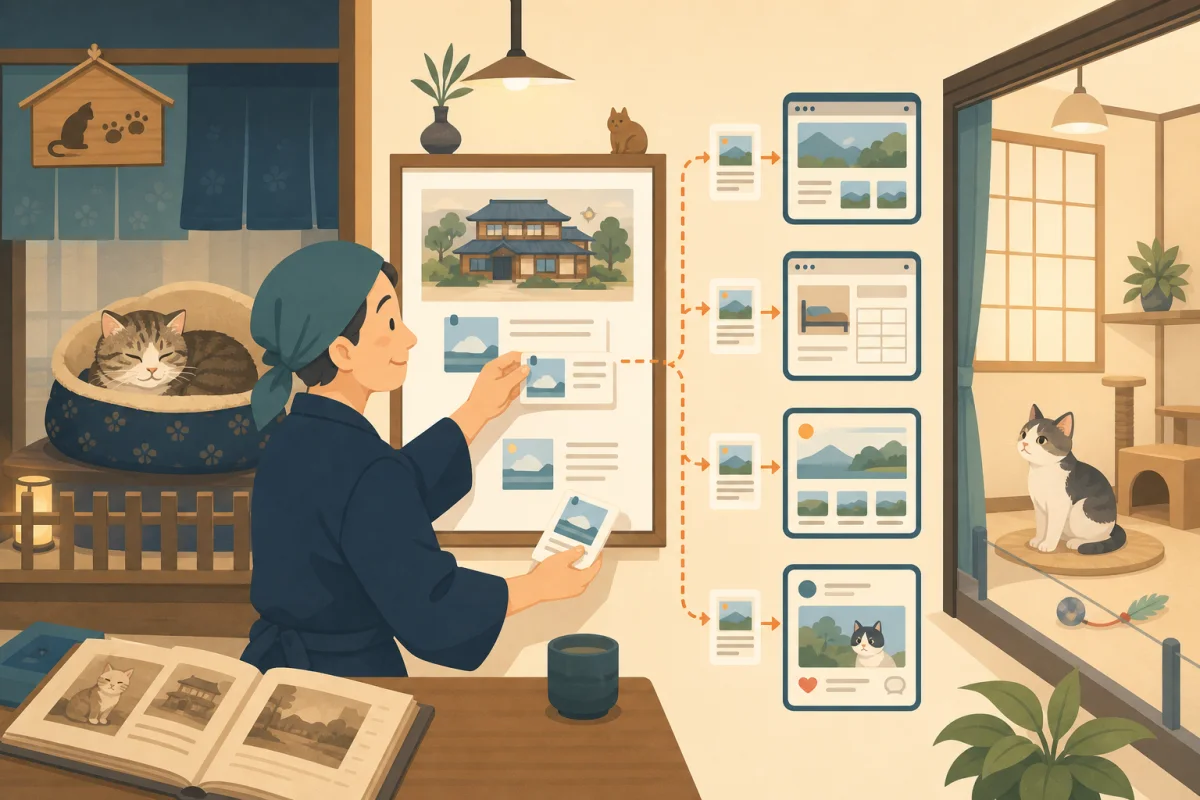
Neko Yado is not just for people who want to pet a lot of cats. It is suitable for people who want to wait to see if a cat approaches, watch them live naturally at the inn, and enjoy hot springs, cooking, buildings, and spending time together in the area.
On the other hand, it is not a place that guarantees your wishes such as “I definitely want to meet a cat,” “I want you to come to the guest room,” or “I want to hold a cat and take a photo.”The distance traveled during the stay will vary depending on the cat’s physical condition, mood, and the rules of the accommodation.
In this article, we will explain how to decide whether a cat inn is right for you, based not on your age or the number of people traveling, but on what you want to enjoy and how far you can accept change.
- Cat Inn is suitable for people who can wait for the cat to choose.
- Nekoyado is recommended for these people
- People who enjoy just looking at cats
- People who can enjoy the inn even when they can’t meet the cat
- Person who can check the rules for each accommodation
- A person who can realistically accept a little hair and the sounds of everyday life.
- A person who can agree on whether you are traveling alone or with a companion.
- People you should consider carefully
- Choose the distance that suits you from A, B, and C
- Self-check before booking
- Summary
- Reference materials
Cat Inn is suitable for people who can wait for the cat to choose.
The best match is with someone who can wait to see if the cat will approach you without trying to get the cat to follow your schedule.
If you find a cat, don’t chase it, don’t wake it up if it’s asleep, pet it briefly and then leave it. If you spend your time in this way, you can enjoy watching the cat live in peace, even on days when you don’t have much contact with them.
Cats Protection advises you to interact with cats according to their wishes and not to pursue them if they leave. AAHA’s Cat Behavior and Environment Guide also explains the importance of allowing cats to indicate that they want to stop or to take a break. Even in a cat hostel, it is important to leave room for the cat to refuse interaction.
If you read First Greetings at a Cat Inn and How to Interact with Cats in advance, you can prepare even if you have no experience raising cats.
Nekoyado is recommended for these people
People who enjoy just looking at cats
A cat looks out by the window, crosses the hallway, and sleeps in its usual spot. People who find it fascinating to quietly observe the daily lives of cats at an inn, even without touching them, will find it easy to enjoy a cat inn.
It is important to not only accept friendly cats as “hits”, but also to accept the fact that cautious cats or elderly cats keep their distance from each other as part of their cat nature.
People who can enjoy the inn even when they can’t meet the cat
Resident cats are not staff members who work set hours for guests. They may be sleeping, spending time elsewhere, or taking time off to take care of their health.
If you have at least one other reason for wanting to stay at this inn other than the cat, such as hot springs, food, gardens, buildings, and walking around the area, you won’t have to rely on the cat’s behavior to determine your travel satisfaction. Please also refer to How to think when you can’t meet a cat.
Person who can check the rules for each accommodation
Places for cats, cuddles, treats, toys, photography, and handling of guest room doors vary by inn. Even if it was allowed at another cat inn in the past, it may not be the same at this inn.
It is suitable for people who can read the official guide, ask questions about things they don’t understand before making a reservation, and prioritize local explanations after arriving.
A person who can realistically accept a little hair and the sounds of everyday life.
At inns where cats roam freely, fur may get on clothing even after cleaning, footsteps may be heard at night, and cat supplies may be kept in shared areas. This does not mean that poor hygiene is acceptable; places where animals live have aspects of daily life that differ from hotels without animals.
You don’t have to put up with the conditions that bother you. If you have any requests such as not wanting to have a cat in the guest room or prioritizing sleep, we will check if this can be accommodated before making a reservation.
A person who can agree on whether you are traveling alone or with a companion.
If you are traveling alone, you have the advantage of being able to spend your time quietly while keeping an eye on the cat. When traveling with family or friends, it’s important that everyone understands the distance from cats, their fur, and their ability to enter the guest room.
Even if you are a cat lover and are making a reservation on behalf of someone who loves cats, it is not enough to just tell your companions that the hotel has cats. Use Things to check when staying with a companion who doesn’t like cats and discuss whether you can spend time without touching them or whether there are any areas where cats are not allowed.
People you should consider carefully
People who want to make contact with cats a mandatory condition
If you have conditions such as “I definitely want to hold you,” “I definitely want to sleep with you,” or “I don’t want to be able to take pictures during my stay,” your expectations may not match up with a typical cat inn.
A on this site is an inn where we have confirmed that “cats sometimes come to the guest room,” but this classification does not guarantee that cats will visit every time. Check the meanings of A, B, and C and choose your distance from the cat.
People with cat allergies or asthma symptoms
Cat allergens are found not only in the cat’s fur, but also in its skin and saliva, and can remain in the environment even when the cat is not present. The ACAAI advises that avoidance is the most effective way to manage cat allergies.
If you have symptoms, please consult a medical professional and check with the inn about the cat’s range of activity and cleaning methods. If there is a possibility of severe symptoms, it is necessary to decide not to choose a cat inn. For more information, please see Cat Allergies and Cat Lodging.
People who have strong anxiety about their companion
Not being good with cats is not a matter of manners. There are many reasons for this, including fear of being approached suddenly, past experiences, allergies, etc. Avoid making reservations without the person’s consent thinking, “If I go, I’ll like it.”
At accommodations where you cannot separate the living space from the cat, it puts a strain on both your companion and the cat. If you don’t feel safe for everyone, choosing something other than a cat hostel will make your trip better.
People who require the same environment as a regular hotel.
If you require a completely hair-free room, no noise from animals at night, and common areas where cat supplies cannot be seen, an accommodation where cats can live freely may not be suitable.
However, an inn where interaction takes place only in a dedicated cat space, or where guests can meet cats only at set times, may suit your needs. Consider a different type of accommodation as well as whether to give up on staying at a cat inn.
People who want to bring their cat
Accommodations with resident cats are different from those that allow guests’ pets. It is not always possible to bring a guest’s cat to a facility that has a resident cat, and cats cannot be allowed to meet each other. Please check Different types of cat accommodations and look for a facility that clearly states “Cats are allowed.”
Choose the distance that suits you from A, B, and C
Neko Yado Research’s A, B, and C indicate points of contact with cats, not recommendation rankings.
- A|Cats may come to the guest room: For people who want to enjoy close proximity, but are also concerned about the safety of doors, luggage, and sleep.
- B|inside the inn/You can interact in a dedicated space: Easy to consider for people who feel safe knowing the place and time of interaction, and for first-time visitors.
- C|Meet the resident cat (unconfirmed contact): For people who want to enjoy the atmosphere of the inn and the appearance of the resident cats without the purpose of touching them.
A is not necessarily the best fit. B may be suitable for those who prioritize sleep, and C may be suitable for those who want to observe the resident cats from a distance. Please compare the characteristics of the region and inn from List of cat inns.
Self-check before booking
See if you can answer “yes” to the following questions. It is not a competition for points, but a check to find questions and conditions.
- Can you enjoy your stay even if you can’t meet the cat?
- If the cat leaves, can you finish without chasing it?
- Can you confirm the rules for holding, snacking, and taking photos?
- Can you explain the acceptable range for cat hair and noises?
- Have you thought about whether you want to bring a cat into the guest room or not?
- Do all the people accompanying you agree to the environment with cats?
- Did you discuss any allergies or health concerns in advance?
- Is there a reason you want to stay at that inn other than the cat?
Even if you are unsure about something, there is no need to immediately conclude that a cat inn is not suitable for you. Use 10 Questions to Ask Before Booking to check with the inn and choose the format that meets your requirements.
Summary
The person suited for a cat inn is not simply someone who likes cats, but someone who can accept the ability to choose whether to let a cat approach, having time when they are not around, and that each inn has different rules.
Rather than thinking about whether you can interact with the cat a lot, it will be easier to choose an accommodation that is compatible with you if you think about whether you can spend your time without disturbing the life of the cat and the accommodation. Choosing another accommodation when the conditions are not suitable is also a decision that respects both the cat and the person traveling with you.
If you are making a reservation for the first time, please also take a look at the Complete Guide for First-time Guests.
Reference materials
- Cats Protection: How to pet a cat
- AAHA: Behavior and Environmental Needs
- American College of Allergy, Asthma & Immunology: Pet Allergies
Note: This article is a guideline for general travel selection. We do not guarantee or diagnose cat behavior or allergic symptoms. Please contact the inn for the latest accommodation conditions, and consult a medical professional for health-related decisions.